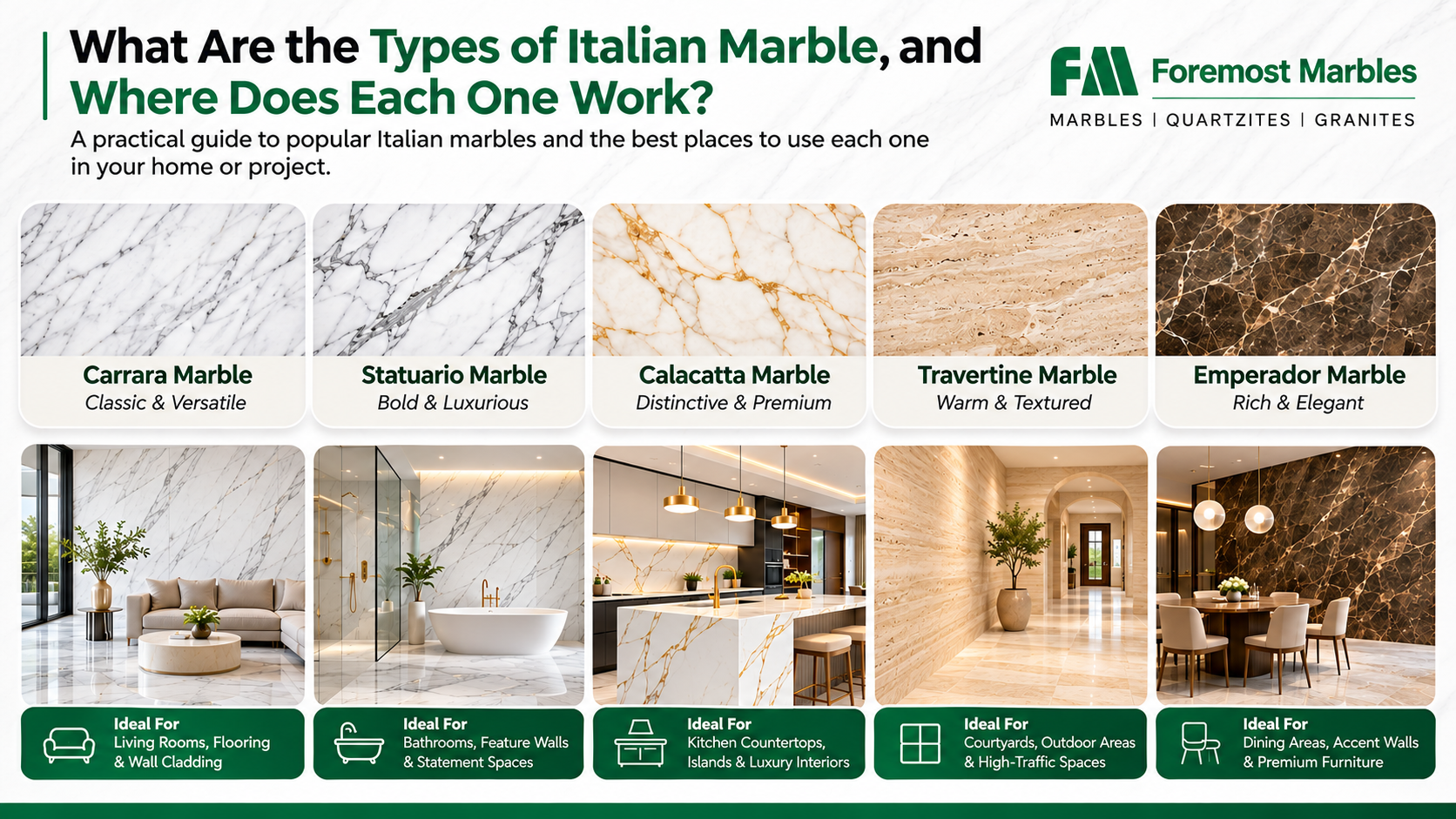
What Are the Types of Italian Marble, and Where Does Each One Work?
- You will learn the main Italian marble names, grouped by colour.
- You will see what each stone looks like when laid on a floor or wall.
- You will find out which rooms in an Indian home suit which stone.
- You will understand why some Italian marbles cost more than others.
- You will get a simple way to pick between two or three finalists.
What Are the Types of Italian Marble, and Where Does Each One Work?
Italian marble comes in far more shades than white. The main types of Italian marble include Statuario, Calacatta and Carrara in white. Botticino is cream, Bardiglio is grey, and Portoro is black. Each has its own vein pattern, mood and best use. Going by name alone is risky, because two slabs sold under one name can look quite different. This guide covers the common Italian marble names and colours. It shows where each one suits an Indian home, and why prices vary from stone to stone.
Quick Picks
| What you want | Why it happens | What to pick |
|---|---|---|
| A bright, airy living room | Pale stones bounce light around | Carrara or Statuario |
| A bold feature wall | Strong veins pull the eye | Calacatta or Portoro |
| A warm, calm bedroom | Cream tones soften harsh light | Botticino or travertine |
| A moody accent | Dark stones add depth | Bardiglio or Portoro |
| A slab that matches the sample | Every block has its own pattern | Choose from the actual slab |
Which types of Italian marble are most common?
Colour is the easiest way to sort them, and each colour family has a handful of well-known names.
According to Visit Tuscany, the region’s official tourism site, marble has been cut around Carrara since Roman times without a break. Several of the names below come from that area. Here are the types of marble buyers ask about most:
- Statuario (white): a bright white base with bold grey veins.
- Calacatta (white): thick, dramatic veins in grey or gold. It is rarer than Carrara.
- Carrara (white to light grey): soft, feathery veins and a calm look. It is the easiest of the three whites to find.
- Botticino (cream): a warm, even cream with faint veining, quarried near Brescia in Lombardy.
- Bardiglio (grey): a blue-grey stone with darker bands, also found near Carrara.
- Portoro (black): deep black with gold veins, from the Liguria coast.
Names can shift between suppliers, so judge the stone by the slab in front of you.
How do you match colour to each room?
Match the colour to how much light the room gets and how bold you want it to feel.
White marble suits living rooms and pooja rooms
White marble reflects light, so hallways and living rooms feel larger. It also stays cool underfoot in a hot summer. Statuario and Carrara handle big floors well, while Calacatta makes a strong statement wall.
Grey and black stones add depth to feature areas
Dark stones draw the eye. A grey marble like Bardiglio suits a TV wall or a bar front. Black marble with gold veins suits a powder room vanity or a small entrance. Too much dark stone in a small room can feel heavy.
Beige and brown tones warm up bedrooms
Cream stones like Botticino soften harsh light and sit well beside wood. The beige marble and brown marble pages show more shades, from soft sand to deeper coffee tones.
Where do travertine, onyx and limestone fit in?
These stones often sit beside Italian marble in a collection, but they are different materials. Travertine has small natural pits and a warm, earthy look. Onyx is softer and glows when light passes through it, so designers use it for backlit panels. Limestone is matte and calm, with a quieter pattern than marble.
Why do prices differ between Italian marbles?
Price depends on how rare the stone is, the quality of the block, the finish and the slab size. Rare stones with bold veins usually cost more than common ones, but costs vary by supplier and by batch. Check directly with the supplier for current pricing, and ask what the quote includes.
Key Takeaways
- Italian marble names fall into colour groups: white, cream, grey and black.
- Statuario, Calacatta and Carrara are the best-known whites, and each has its own vein style.
- Light stones suit bright rooms, and dark stones work best as accents.
- Travertine, onyx and limestone are related stones, not marbles.
- Prices vary, so ask the supplier for a current quote.
Expert Note
Ask to see the full slab before you decide. A hand sample comes from one spot, and veins can shift a lot across a whole slab. View it in daylight from a few steps back. Then ask for pieces from the same block, so the floor reads as one even surface.
When is Italian marble not the right choice?
Italian marble is a natural stone that can scratch and develop dull etch marks when exposed to acidic substances such as lemon juice or vinegar. In a home with heavy daily traffic or frequent spills, a harder stone may suit you better. Marble also needs sealing and regular care. If you are weighing options, read our guide on the difference between granite and marble.
What should you do next?
Choose the colour first, then the vein. Light stones open up a room, dark ones add weight, and cream ones keep things calm. See real slabs before you decide, and ask for pieces from one block. When you are ready, download the catalogue, then request a quote from the Foremost team. They can help you narrow the types of Italian marble down to the two or three that fit your home.
FAQs
Q: What are the different types of Italian marble?
Italian marble names fall into colour groups. White includes Statuario, Calacatta and Carrara. Botticino is cream, Bardiglio is grey and Portoro is black. Travertine, onyx and limestone are often sold alongside them, though they are technically different stones, so ask which one you are being shown.
Q: Which Italian marble is the most popular?
Q: What colours does Italian marble come in?
Q: Is Italian marble good for Indian homes?
Q: How do I choose between Italian marble varieties?
Start with colour, then vein, then where it will go. Look at a full slab in daylight. Ask for slabs from one block so the pattern stays even. Compare two or three Italian marble varieties side by side before you decide.
Visit or Contact Foremost Marbles
Mumbai Showroom
Foremost Marbles, Rockwell Compound, Marble Market, Airport Side Service Road, Navpada, Near Domestic Airport, Western Express Highway, Vile Parle East, Mumbai – 400099
Silvassa Factory & Stockyard
Foremost Marbles, 327, Naroli Bhilad Main Road, Village Athal, Silvassa – 396230
Call/WhatsApp: +91‑81603 16958 / +91‑99136 97614
Email: [email protected]
Ready to Elevate Your Space?
Choose from India’s finest collection of imported stones and give your interiors the elegance they deserve.
Contact Foremost Marbles today and explore a world of premium natural stone.