Italian Marble vs Indian Marble: Which One Is Right for Your Home?
What This Post Covers
- You will get a side-by-side look at both stones, from looks to daily wear.
- You will see a clear winner for living spaces and another for busy floors.
- You will learn what Makrana and other Indian marbles do well.
- You will get room-by-room advice you can use right away.
- You will know what to check before you place an order.
Italian Marble vs Indian Marble: Which One Is Right for Your Home?
Pick Italian marble for looks and Indian marble for hard daily wear. That is the short answer in the Italian marble vs Indian marble debate. Italian stones bring bold veins and many colours. Indian stones, like Makrana, are often denser and more forgiving. Both are real marble, and both can look great in the right room. This guide puts them side by side, names a winner for each use, and lists the checks to make before you order. Here is how to decide without guessing.
Quick Answers
| Problem | Reason | Answer |
|---|---|---|
| Floor scratches quickly | Soft stone meets heavy foot traffic | Pick a denser stone or honed finish |
| Spills leave dull marks | Acids react with marble | Seal it and wipe spills fast |
| You want dramatic veins | Few Indian stones have bold patterns | Look at Italian white marbles |
| Bathroom floor feels slippery | Polished stone gets slick when wet | Choose a honed or textured finish |
| Two stones look alike in photos | Names and shades differ by supplier | Compare real slabs in daylight |
How do you compare Italian marble vs Indian marble side by side?
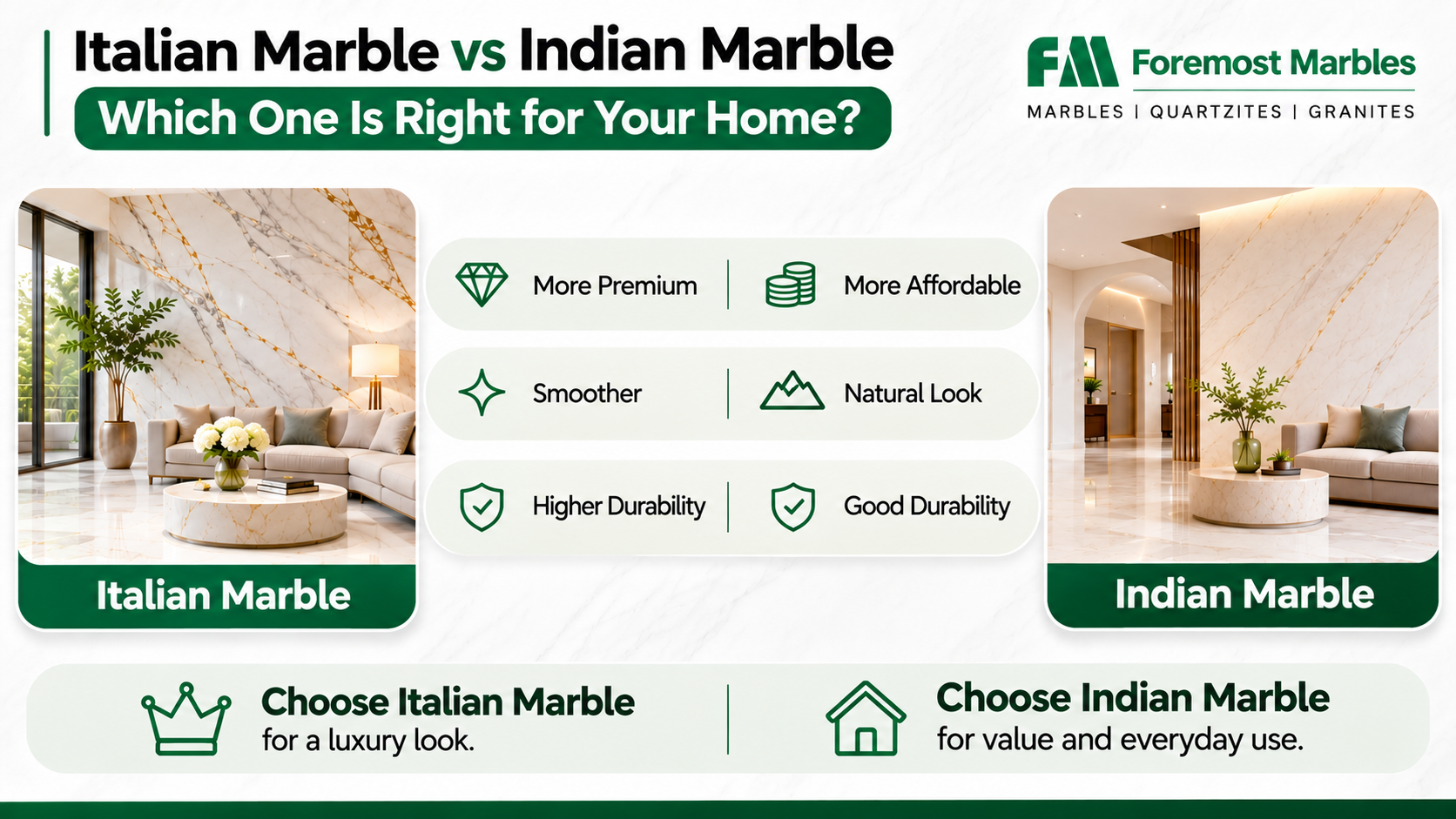
Italian marble leads on pattern and colour, while Indian marble often leads on hardness and water resistance.
| Feature | Italian marble | Indian marble |
|---|---|---|
| Look | Bold veins, many colours | Whites, creams, greens and pinks |
| Main source | Tuscany and other parts of Italy | Mainly Rajasthan |
| Hardness | Often softer, so it scratches sooner | Often harder, so it wears slowly |
| Water soak | Can absorb more if unsealed | Often absorbs less |
| Best for | Living rooms, feature walls, bedrooms | Busy floors, steps, bathrooms |
| Care | Seal it and wipe spills fast | Seal it, but it forgives wear more |
These are general trends, and every stone is different. Ask your supplier for test details on the exact stone you like.
Winner: Italian marble takes it for living rooms and feature walls, where looks come first. Indian marble takes it for busy, wet or high-wear floors. If you want one answer for a main hall, Italian marble gives you the pattern people remember. Just plan for sealing and gentle care.
What do Indian marbles like Makrana do better?
Indian marbles, especially Makrana, are often denser and take in less water than many Italian whites.
According to the International Union of Geological Sciences, Makrana marble was named a Global Heritage Stone Resource in 2019. Banswara White and Udaipur Green are other well-known marble types in India. For busy floors, steps and bathrooms, that extra toughness matters.
Where does Italian marble make more sense?
It makes more sense wherever you want the stone to be the star. Good spots include:
- Living room floors that get plenty of daylight.
- A feature wall behind a sofa or a bed.
- Master bedroom floors, where foot traffic is light.
- Powder room vanities and walls.
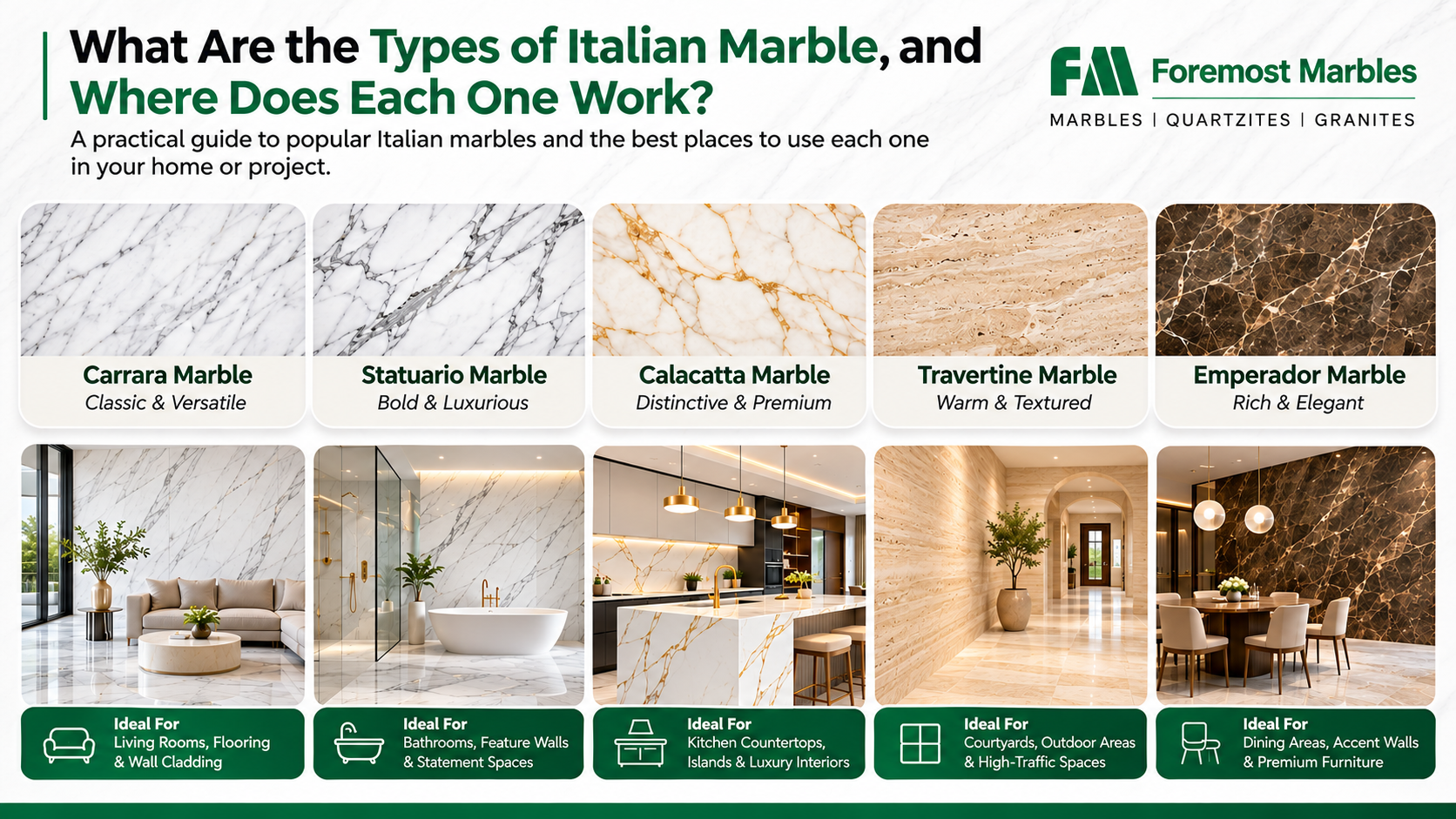
Italian marble in India is imported, so ask your supplier about stock, slab sizes and lead time. Italian marble price in India also varies by stone and batch, so check the current white marble price directly with the supplier. To see the range first, browse the marble varieties or read about the different types of marble.
How do you pick the right stone for each room?
Start with how the room is used, then choose the look.
- Living room: Italian marble for the look, or a dense Indian white if kids and pets are home.
- Bedroom: either stone works, so pick by pattern.
- Bathroom: Indian marble, or a honed Italian stone with a grippy finish.
- Entrance and steps: Indian marble, because it takes heavy wear better.
If you want something different from both, travertine marble offers a rustic, earthy option.
Key Takeaways
- Italian marble wins on pattern, colour range and polish.
- Indian marble often wins on hardness and low water take-up.
- Choose by how the room is used, not only by a photo.
- Both stones need sealing and gentle cleaners.
- Always judge the stone on a full slab in daylight.
Expert Note
Put a few drops of water on an unsealed offcut from your own block. If the spot darkens fast and stays dark for minutes, the stone is thirsty and needs sealing before it goes down. Test your own offcut, not a showroom sample, because blocks differ.
When is each stone not the right choice?
Italian marble scratches and etches more easily, so skip it for floors with heavy daily wear. Indian marble has fewer bold patterns, so it may feel plain in a statement space. Neither stone likes acids or harsh cleaners. Decide by how the room is used, not by a photo.
What should you do next?
Use Italian marble where the stone is the star, and Indian marble where the floor works hard. Many homes mix both stones, so you do not have to choose one for every room. Look at full slabs in daylight, and ask for test details on the stone you like. Then contact Foremost Marbles to request a quote. A real slab will settle the Italian marble vs Indian marble question faster than any photo.
FAQs
Q: Italian marble vs Indian marble: which is better?
Q: What is the difference between marble and Italian marble?
The difference is origin and pattern. Marble is the type of stone. Italian marble simply means it was quarried in Italy, such as in Tuscany. Italian stones are known for bold veins, while Indian marble mostly comes from Rajasthan. Check the quarry name on your quote.
Q: Is Italian marble used in India?
Q: What are the main marble types in India?
Q: What affects Italian marble price in India?
Visit or Contact Foremost Marbles
Mumbai Showroom
Foremost Marbles, Rockwell Compound, Marble Market, Airport Side Service Road, Navpada, Near Domestic Airport, Western Express Highway, Vile Parle East, Mumbai – 400099
Silvassa Factory & Stockyard
Foremost Marbles, 327, Naroli Bhilad Main Road, Village Athal, Silvassa – 396230
Call/WhatsApp: +91‑81603 16958 / +91‑99136 97614
Email: [email protected]
Ready to Elevate Your Space?
Choose from India’s finest collection of imported stones and give your interiors the elegance they deserve.
Contact Foremost Marbles today and explore a world of premium natural stone.