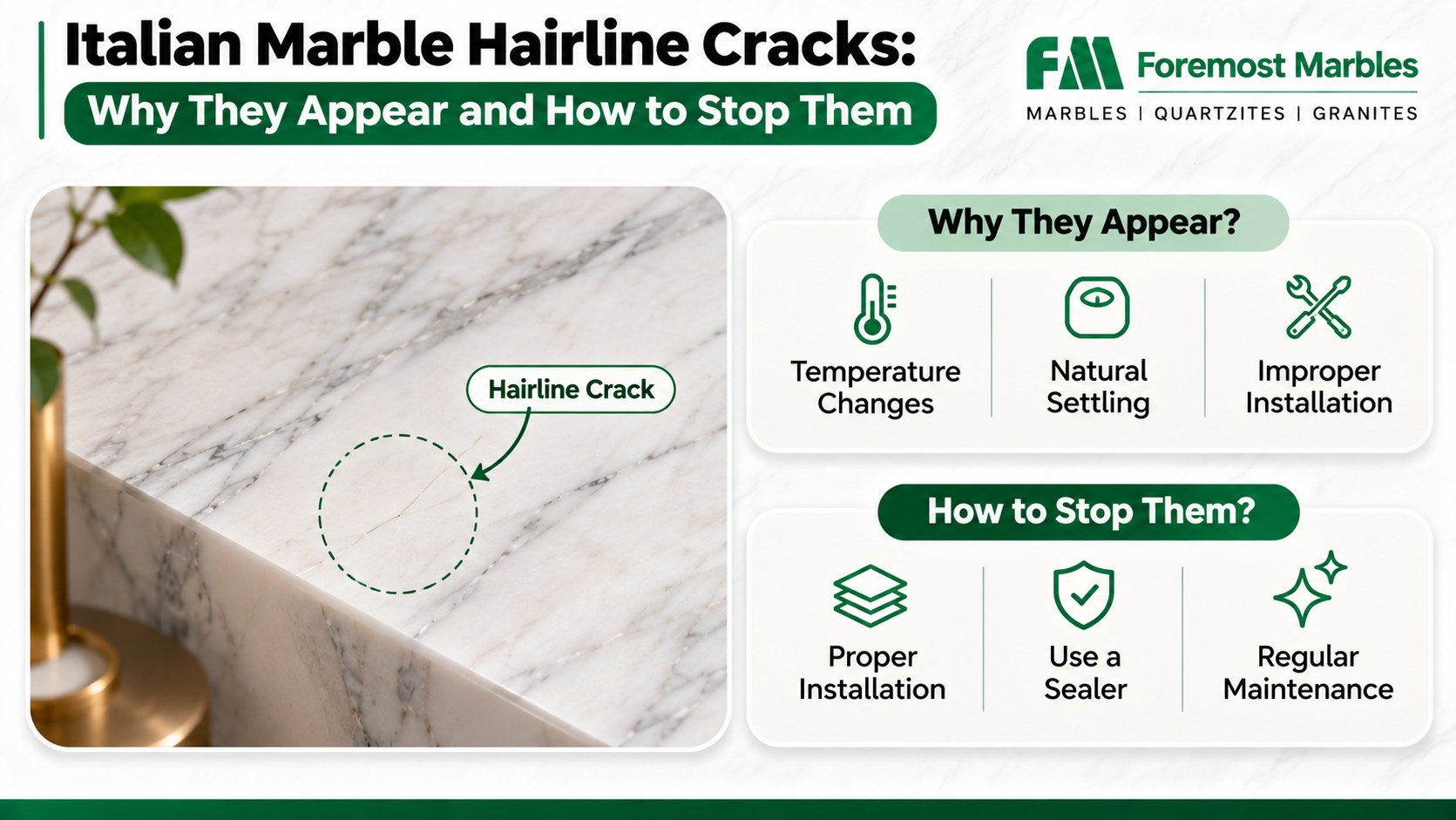
Italian Marble Hairline Cracks: Why They Appear and How to Stop Them
What This Post Covers
- You will learn the five common causes of hairline cracks in marble floors.
- You will see how slab thickness and laying change the risk.
- You will get five questions to ask your installer before work starts.
- You will find out what to do if a crack has already shown up.
What Is a Hairline Crack?
A hairline crack is a very thin line on the surface of the stone, often too fine to catch with a fingernail. Some are natural lines already in the slab. Others form after laying, when the floor moves or the slab has no support underneath. Knowing which kind you have decides the fix.
Italian Marble Hairline Cracks: Why They Appear and How to Stop Them
Yes, Italian marble hairline cracks do happen. Most trace back to how the floor was laid, or to natural lines already in the slab. You can lower the risk with a firm base, the right slab thickness and careful laying. Below you will find the main causes and five questions for your installer. You will also see what to do if a crack has already shown up. Read it before the first slab goes down. Early checks are simpler than repairs.
Quick Diagnosis
| What you see | Likely cause | What to do |
|---|---|---|
| A crack follows a vein | A natural fissure in the slab | Inspect slabs before laying |
| Straight cracks across slabs | The base moved or settled | Fix the base first |
| A hollow sound when tapped | A gap under the slab | Relay with full adhesive coverage |
| Cracks near walls and doors | No room for movement | Add movement joints |
| Cracks under heavy loads | A thin slab or a weak base | Check thickness and support |
What causes Italian marble hairline cracks?
Most hairline cracks in Italian marble come from the base, the laying method or the slab itself. Here is what usually sits behind them:
- Natural fissures. Marble is a natural stone, so some slabs carry fine lines from the quarry.
- A moving base. If the floor underneath settles or flexes, the stone above takes the strain.
- Hollow spots. A slab with gaps under it is unsupported, and a heavy step can crack it.
- Thin slabs. Thinner cuts have less strength, especially over a weak base.
- No movement joints. Stone and concrete swell and shrink with heat and damp, and tight edges have nowhere to go.
Often it is a mix of two or more causes, which is why a careful check beats a quick guess.
How thick should a marble floor slab be?
Floor slabs are commonly about 18 mm thick, though the right figure depends on the stone and the base. Many imported stones in Foremost’s range are listed at 18 mm, so check the exact figure for yours.
Italian marble thickness matters most over a weak base, because thin cuts have less strength. If you choose thinner marble slabs, ask your supplier whether they need extra support.
What should you ask your installer before laying starts?
Ask these five things before any slab touches the floor.
- How will the base be prepared? It should be firm, level and fully cured. Common Mistake: Laying over a base that still has old cracks or loose patches.
- How will the adhesive be spread? Full coverage under each slab leaves no hollow spots. Pro Tip: After laying, tap each slab with a knuckle. A hollow sound means a gap.
- What is the slab thickness, and how is it supported? A good marble flooring procedure matches slab thickness to the base.
- Where will the movement joints go? According to the TCNA EJ171 movement joint guideline, interior floors need joints about every 20 to 25 feet (roughly 6 to 7.5 metres). Add joints along walls and where the flooring changes.
- How will each slab be checked first? Wet it and look at it in daylight. Fine natural lines can hide among the veins, especially in busy patterns like the stones used for white marble flooring.
Good installers expect these questions, and their answers tell you a lot about the job.
Do some Italian stones crack more easily than others?
Yes, softer, thinner or more fragile stones need extra care.
Travertine stone has natural pits that are often filled at the factory, so check the filling after laying. Onyx marble is brittle and is often sold with a reinforced backing. Any stone, from a grey marble slab to a cream one, needs the same slab-by-slab check.
Can you fix hairline cracks once they show?
Often yes, if the base is sound. A fine crack can be filled with a colour-matched resin, which hides it and stops dirt from collecting. If cracks keep spreading or the floor sounds hollow, the base may be moving, and filling will not last. Have your installer look first.
Key Takeaways
- Most hairline cracks come from the base, the laying or natural lines in the slab.
- Floor slabs are commonly about 18 mm thick, but confirm the figure for your stone.
- Full adhesive coverage removes the hollow spots that cause many cracks.
- A wet-slab check before laying catches natural fissures early.
Expert Note
Before laying, wet each slab and look at it at an angle in daylight. Natural fissures show as fine dark lines. Set those slabs aside for low-traffic corners, or cut around them. Do this before adhesive goes on, because once a slab is fixed you cannot inspect it again.
What are the honest limits of prevention?
No installer can promise that a marble floor will never crack. Marble is a natural stone with natural lines, and buildings move over time. Good laying lowers the risk, but it cannot remove it. If you need a floor that is guaranteed flawless, a natural stone may not be the right material for you.
Where should you start?
A good marble floor starts long before the first slab goes down. Check the base, ask about thickness, plan the joints and inspect every slab. If you would like to see the stone first, book a visit to the Silvassa stockyard. Ask the team about slabs for your project. Request a quote when you are ready, and bring your questions. That way you can plan with fewer worries about Italian marble hairline cracks.
FAQs
Q: What causes Italian marble hairline cracks?
The usual causes are a weak or moving base, hollow spots under the slab, missing movement joints and natural lines in the stone. Careful inspection and laying lower the risk, but no installer can promise a floor will never crack.
Q: Are hairline cracks in marble dangerous?
Usually not. They are mostly cosmetic. But if they widen, spread or come with a hollow sound, the base may be moving. Ask an installer to check the floor before the problem grows. A quick tap test is a good first step.
Q: How thick should an Italian marble floor be?
The usual thickness is about 18 mm for floor slabs. Italian marble thickness and marble floor thickness both affect strength. Confirm the exact figure for your stone, and match it to the base. Ask your supplier to put it in writing.
Q: What is the right marble flooring procedure?
A good marble flooring procedure starts with a firm, level, cured base. Then come full adhesive coverage, movement joints, careful curing and sealing. Ask your installer to explain each step before work begins. Write the plan down so everyone follows the same steps.
Q: How can I check the quality of marble laying?
Tap each slab with a knuckle after laying. A solid sound means full support, and a hollow sound means a gap. Check joints near walls and doors too. Good marble laying leaves flat slabs, even joints and no loose edges.
Visit or Contact Foremost Marbles
Mumbai Showroom
Foremost Marbles, Rockwell Compound, Marble Market, Airport Side Service Road, Navpada, Near Domestic Airport, Western Express Highway, Vile Parle East, Mumbai – 400099
Silvassa Factory & Stockyard
Foremost Marbles, 327, Naroli Bhilad Main Road, Village Athal, Silvassa – 396230
Call/WhatsApp: +91‑81603 16958 / +91‑99136 97614
Email: [email protected]
Ready to Elevate Your Space?
Choose from India’s finest collection of imported stones and give your interiors the elegance they deserve.
Contact Foremost Marbles today and explore a world of premium natural stone.