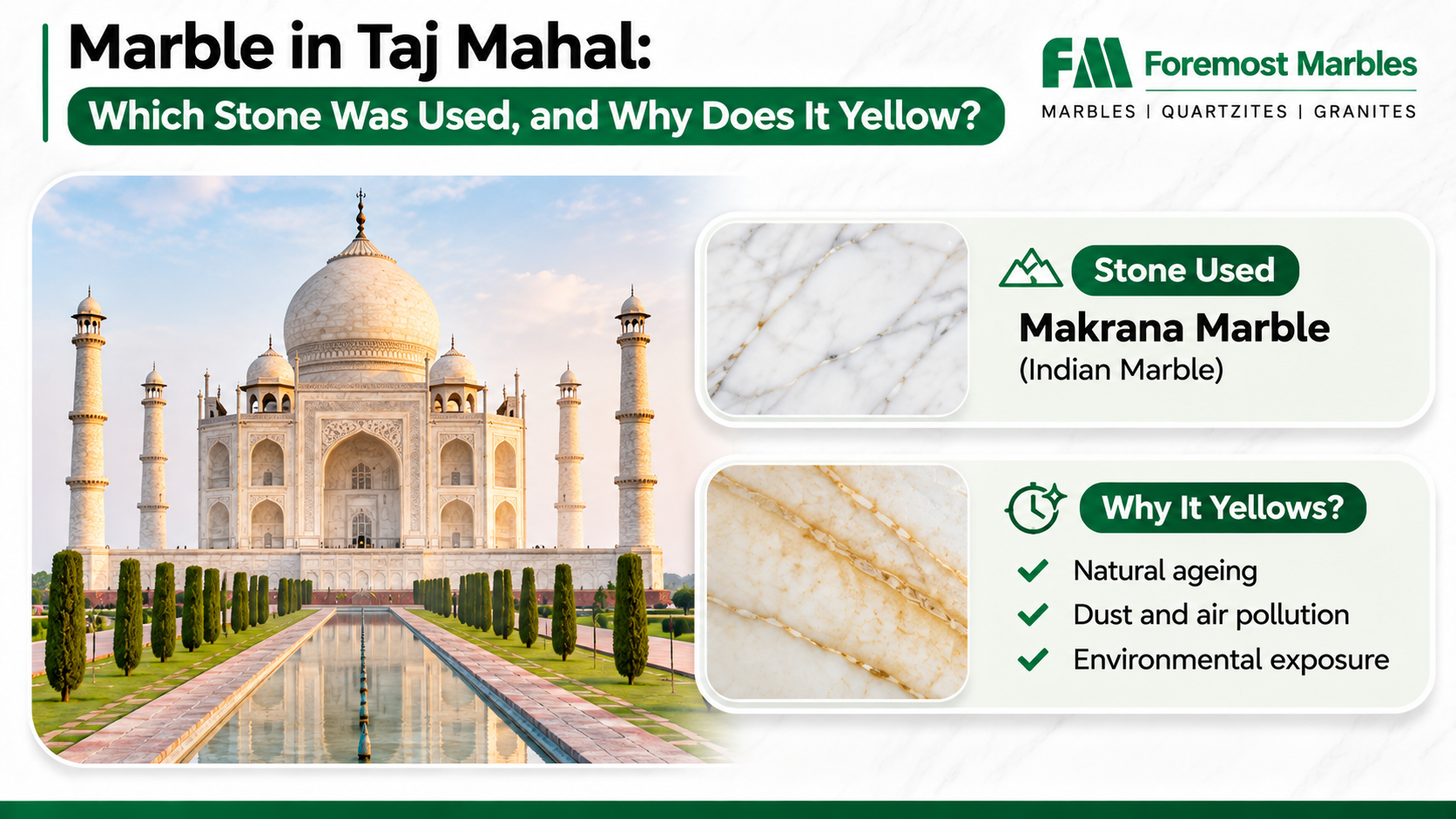
Marble in Taj Mahal: Which Stone Was Used, and Why Does It Yellow?
What This Post Covers
- You will learn which stone built the Taj Mahal and where it came from.
- You will see why the white surface turns yellow in places.
- You will find out how the monument is cleaned.
- You will pick up care habits you can use for white marble at home.
What Is Makrana Marble?
Makrana marble is a white stone from the town of Makrana in Rajasthan. It is almost pure calcite, a mineral form of calcium carbonate, which gives it a clean white colour and a soft glow. It has been quarried for centuries, and in 2019 it was named a Global Heritage Stone Resource.
Marble in Taj Mahal: Which Stone Was Used, and Why Does It Yellow?
The marble in Taj Mahal is white Makrana marble from Rajasthan. Its clean white colour and soft glow made it the stone of choice for the builders. Over time, parts of the surface have turned yellowish, and air pollution is a key reason. This guide covers where the stone came from, why it changes colour and how the monument is cleaned. You will also get care tips for white marble in your own home. Short answers come first, and the details follow.
Quick Answers
| Question | Reason | Answer |
|---|---|---|
| Which marble was used? | A local stone from Rajasthan | Makrana white marble |
| Why did it turn yellow? | Dust and soot settle on the surface | Cleaning, plus less pollution |
| Why are there green patches? | Insects near the river leave waste | Regular cleaning |
| How is it cleaned? | A clay pack pulls dirt out | Fuller’s earth pack, then a wash |
| Will my floor yellow too? | Home yellowing comes from stains and cleaners | Seal it and wipe spills fast |
What is the marble in Taj Mahal, and where does it come from?
White Makrana marble, quarried in the town of Makrana in Rajasthan, forms the Taj Mahal.
According to the IUGS Subcommission on Heritage Stones, this marble is used throughout the building. That includes the white dome and the fine inlay work. The same stone went into the Victoria Memorial in Kolkata. Makrana white is dense, takes a good polish and is often described as absorbing little water.
Why does the Taj Mahal marble turn yellow?
Dust and soot in the air settle on the surface and give it a yellow tinge.
According to a report covered by NBC News, tiny airborne particles that land on the white marble add that yellow tint. News reports on India’s Supreme Court hearings also name insect waste from the polluted river nearby. Algae is another cause of the green and brown patches. In 1996 the court set up the Taj Trapezium Zone, a protected area with tighter pollution rules.
How is the Taj Mahal marble cleaned?
Conservators spread a clay paste called Fuller’s earth on the marble, then wash it off.
According to The National, the Archaeological Survey of India uses these mud packs. They pull dirt out of the stone as they dry. The treatment is slow on purpose. It helps, but it cannot fix the cause, which is the pollution itself.
What does this mean for white marble at home?
Indoors, yellowing mostly comes from spills, oils, harsh cleaners or old sealer. A few habits keep a floor looking clean:
- Seal the stone after laying, and again when the supplier advises.
- Wipe spills at once, especially oil, tea and anything acidic.
- Clean with a mild, pH-neutral cleaner.
- Skip lemon, vinegar and bathroom acids on marble.
These habits matter for any white marble slab, whether it comes from Rajasthan or Italy. If you are still choosing a stone, our guide to the best marble for home compares your options. The marble collection shows what Foremost carries.
Key Takeaways
- The Taj Mahal is built with white Makrana marble from Rajasthan.
- Dust, soot and insect waste are behind much of the discolouration.
- Fuller’s earth packs clean the stone, but pollution control matters most.
- At home, yellowing mostly comes from stains, oils and harsh cleaners.
- Sealing and gentle cleaning protect any white marble.
Expert Note
Seal marble before the joints are filled. Grout and adhesive can leave marks in an unsealed surface that are very hard to lift later. Seal first, fill the joints, then seal once more after the floor has cured. Test the sealer on an offcut first, so you know how it changes the colour.
When is Makrana marble not the right choice?
Makrana is mostly plain white, so it will not give you bold veins or deep colours. It also stains and etches like any marble. If you want drama or texture, an imported stone may suit you better. A limestone can also work for a softer look, and you can see how marble and limestone differ before you decide.
What should you do next?
The Taj Mahal shows how much people admire a good white stone, and how much it needs care. Browse the Foremost range for a pattern you like, such as luxury marble for a showpiece wall. When something catches your eye, ask the team for a quote. Look at full slabs if you can, since photos hide a lot. With the marble in Taj Mahal and its care needs clear, choosing a stone for your own home gets easier.
FAQs
Q: What is the marble in Taj Mahal called?
The marble in Taj Mahal is called Makrana marble. It is white, dense and almost pure calcite. It was quarried in Makrana, Rajasthan, and it was also used for the Victoria Memorial in Kolkata. Makrana marble was named a Global Heritage Stone Resource in 2019.
Q: Why is the Taj Mahal turning yellow?
Dust and soot from the air settle on the white marble and add a yellow tint. Insect waste from the nearby river and algae can also stain it green or brown. Conservators clean it with Fuller’s earth packs. Cleaner air is the lasting fix.
Q: Where is the marble of Taj Mahal from?
The marble of Taj Mahal comes from Makrana, a town in Rajasthan known for white marble. The town is often called the marble city of India. Makrana marble is still quarried there today. Several other landmarks use the same stone. It is a calcite marble with very few impurities.
Q: Is Taj Mahal white marble the same as Italian marble?
No. The Taj Mahal white marble was quarried in Rajasthan, while Italian marble comes from places like Tuscany. Both are marble, but they differ in grain, veins and feel. Italian stones usually show bolder veins. Neither is better everywhere, since each suits different rooms.
Q: Can I use Makrana white marble at home?
Yes. Makrana white marble suits floors and walls, and it is known for taking a good polish. Seal it, wipe spills fast and use gentle cleaners. Like all marble, it can stain and etch. Ask your supplier for a slab to inspect first.
Visit or Contact Foremost Marbles
Mumbai Showroom
Foremost Marbles, Rockwell Compound, Marble Market, Airport Side Service Road, Navpada, Near Domestic Airport, Western Express Highway, Vile Parle East, Mumbai – 400099
Silvassa Factory & Stockyard
Foremost Marbles, 327, Naroli Bhilad Main Road, Village Athal, Silvassa – 396230
Call/WhatsApp: +91‑81603 16958 / +91‑99136 97614
Email: [email protected]
Ready to Elevate Your Space?
Choose from India’s finest collection of imported stones and give your interiors the elegance they deserve.
Contact Foremost Marbles today and explore a world of premium natural stone.